Article
Why There’s Still No Perfect EMR for Longevity Medicine – and How AI Will Eventually Build One
25 October 2025
The Problem Beneath the Progress
Longevity medicine promises something extraordinary, the ability not just to treat disease, but to extend the healthspan of human life. Yet behind the glossy architecture of longevity clinics and AI-enabled diagnostics lies a quiet dysfunction: our digital systems are still built for a world that no longer exists.
Every longevity clinician and operator eventually faces it, the moment an electronic medical record (EMR) limits rather than enables care. The technology that once revolutionized hospitals has become the bottleneck for the next frontier of medicine.
1. EMRs Were Built for Episodes, Not Ecosystems
The first generation of EMRs was engineered for acute, episodic encounters. They captured diagnoses, procedures, and billing codes, data designed to close a loop. But longevity medicine operates on an open loop.
It tracks trajectories, not transactions. It documents evolution, not events.
Patients aren’t discharged; they are observed, optimized, and supported through continuous feedback loops of biological data. In a field that values prevention over pathology, the legacy EMR’s architecture feels like a cage around a living system.
2. The Complexity of Longevity Data
A single longevity patient can generate thousands of data points across multiple systems:
- Multi-Omics: genomic, epigenetic, proteomic, metabolomic, and microbiome data
- Functional Testing: hormone mapping, advanced metabolic panels, mitochondrial efficiency
- Continuous Monitoring: wearables tracking HRV, sleep, glucose, activity, and temperature
- Behavioral & Cognitive Metrics: psychological resilience, attention, and mood variability
- Environmental Inputs: nutrition, circadian rhythm, air quality, and stress biomarkers
This is heterogeneous, longitudinal, and non-linear data. Traditional EMRs, optimized for relational databases and billing events, are simply not built to manage such complexity. The result: critical insights remain trapped in PDF uploads or static lab attachments, disconnected from the clinician’s decision-making interface.
3. AI: The Interpreter Between Biology and Insight
Artificial Intelligence is not here to replace the EMR – it is here to translate it.
AI offers the computational depth required to unify chaos into coherence:
- Natural-language processing can structure narrative clinical notes into usable datasets.
- Machine-learning models can identify patterns of biological age acceleration before symptoms appear.
- Predictive analytics can anticipate cellular aging trajectories under different lifestyle or therapeutic interventions.
- Generative interfaces can summarize a decade of patient data into an actionable, human-readable dashboard.
Where legacy EMRs record the past, AI reveals the direction of health.
4. Why AI Hasn’t Solved It Yet
AI’s potential is vast – but it thrives on standardized, clean, and connected data. Longevity medicine, in its current form, is none of those things.
Most longevity datasets are small, proprietary, and formatted differently across labs and platforms. There is no shared ontology for what “optimal” mitochondrial function or “reversed epigenetic drift” looks like. Without interoperability standards (FHIR, HL7, or equivalent APIs), even the most advanced AI model remains siloed – brilliant, but blind.
Until clinics integrate data-lake architecture and shared governance frameworks, AI will remain an assistant at the edge of the ecosystem, not the intelligence at its core.
5. The Hybrid Intelligence Stack
The EMR of the future will not be a single platform. It will be a hybrid intelligence stack – a symbiosis of structure and adaptability.
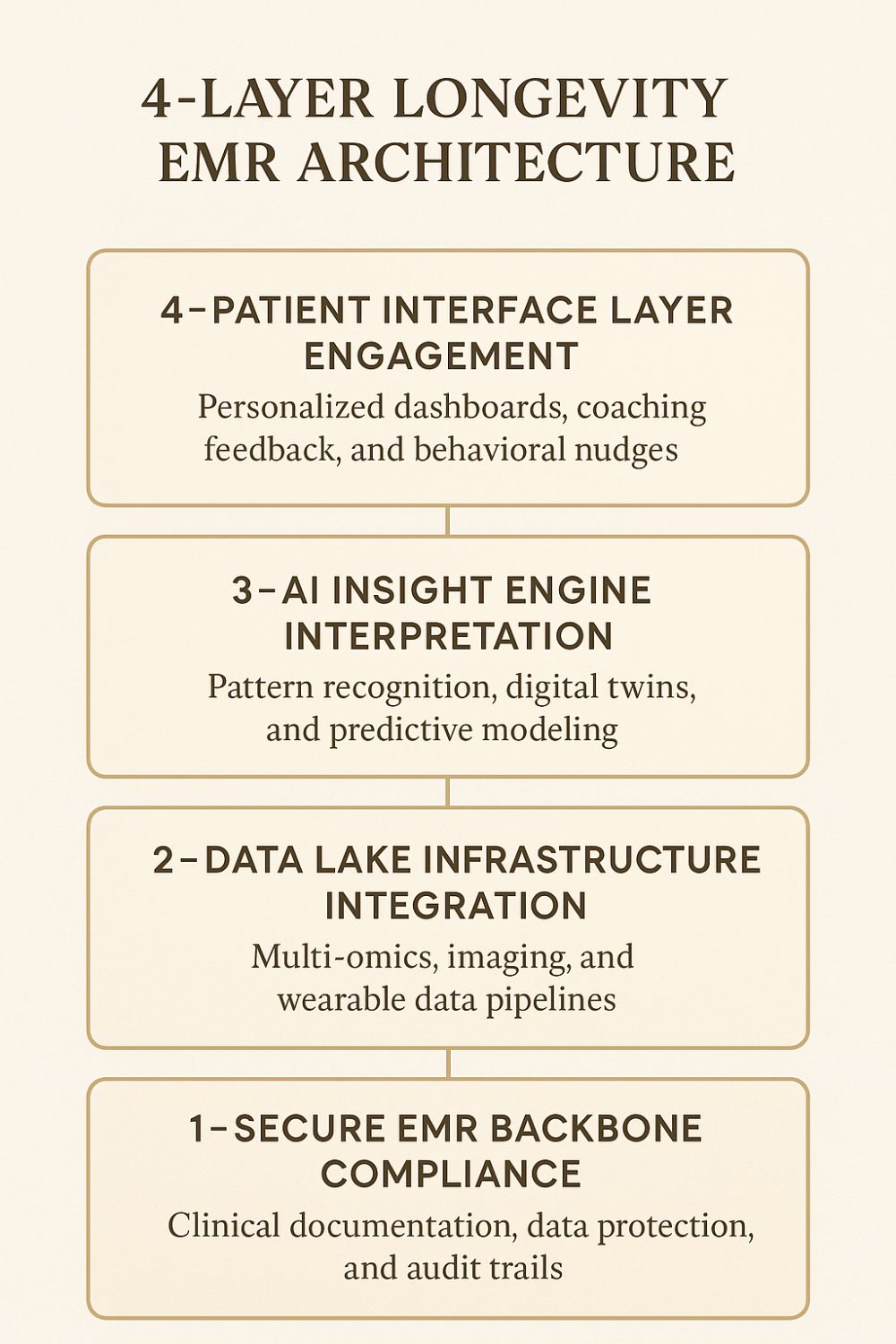
The four layers of a hybrid intelligence stack bridging AI and clinical operations.The four layers of a hybrid intelligence stack bridging AI and clinical operations.The four layers of a hybrid intelligence stack bridging AI and clinical operations.The four layers of a hybrid intelligence stack bridging AI and clinical operations.
This architecture won’t replace the clinician, it will augment their intuition. It will merge medical reasoning with machine learning to form a continuous loop of learning where every patient interaction improves the next.
6. The Role of the Operator
The evolution of longevity medicine won’t be driven solely by algorithms; it will depend on the operators who understand both science and system design.
Operators must bridge regulation with innovation, ensuring that technology enhances, not erodes the human touch. They must curate ecosystems where clinicians, data scientists, and patient-experience specialists work through a shared operational language.
Because AI can decode biology, but humans must design meaning.
7. Building for a Living System
Longevity medicine isn’t about extending lifespan; it’s about extending coherence between data and decision, between clinician and patient, between system and soul.
To get there, we must stop forcing 21st-century medicine to run on 20th-century software. We need systems that think, learn, and evolve just as biology does.
Until then, we will keep building bridges, one workflow, one algorithm, one patient journey at a time.
#LongevityMedicine #AIinHealthcare #DigitalHealth #HealthcareInnovation #PatientExperience #Leadership #DenitaOnLeadership