Article
What the East Already Knows About Longevity
11 October 2025
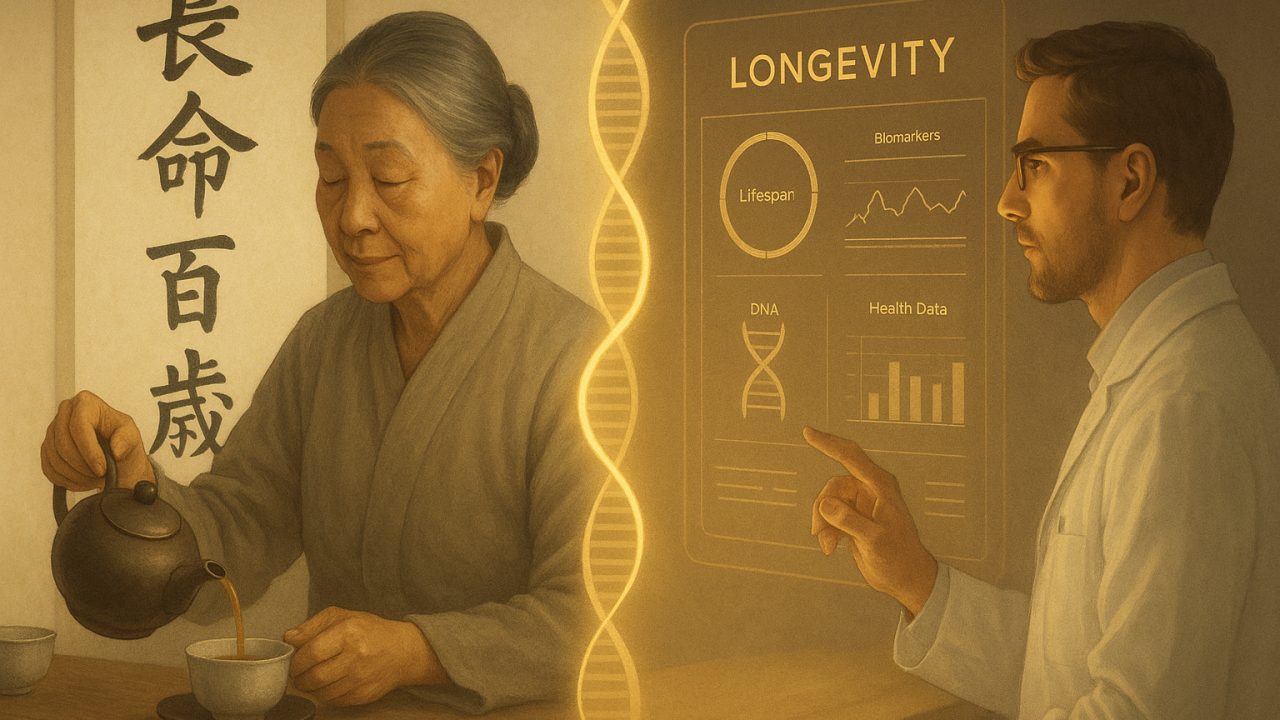
I grew up in a Chinese household where longevity was not a pursuit, it was a presence. It lived in the rhythm of our days, in the sound of my grandmother’s porcelain teacups, in the patience of her simmering soups, and in the quiet rituals that anchored our home.
Every action carried intention. Tea wasn’t brewed to quench thirst, but to restore balance. Meals weren’t measured in calories, but in yin and yang. Rest wasn’t a weakness, it was a virtue, a way to honour the body that carries us through life.
My grandfather used to say, “养生不在医,贵在养心” – health is not found in medicine, but in the nourishment of the heart. He didn’t have a degree in biology, but he understood the poetry of homeostasis long before I learned the science of it.
A Life Rooted in Rhythm
In our culture, longevity is not an achievement; it’s an inheritance of wisdom. To live long is to live in harmony with nature, with others, and with oneself. We were taught to eat seasonally, to rise with the sun, to slow down when it rains, to be humble when life gives abundance.
When someone fell ill, the elders didn’t ask, “What’s the diagnosis?” They asked, “Where have you lost your balance?” Because illness, to them, wasn’t the invasion of disease – it was the quiet rebellion of imbalance.
Even our greetings reflect this. “长命百岁” – may you live a hundred years. “身体健康” – may your body be strong. Longevity isn’t an aspiration in our world; it’s a wish spoken daily, a cultural heartbeat.
The West Is Only Catching Up
Now, years later, I find myself working at the intersection of science and philosophy, in the very space where East and West are beginning to meet. As an operator of longevity clinics and someone deeply involved in regenerative medicine, I often smile when I see how modern science is rediscovering what my grandparents already knew intuitively.
Autophagy, telomeres, mitochondrial health, cellular senescence, all these scientific marvels are simply new expressions of ancient truths. What the West calls intermittent fasting is what the East practiced through periodic abstinence and simplicity. What we now call stress modulation was once Qi balance. What we measure in biomarkers, our elders observed through complexion, breath, and spirit.
The West quantifies what the East embodied.
The Future Is Integration
True longevity, is about adding life to years. The East teaches us to listen inward, to harmonize energy, to respect time. The West teaches us to measure, to optimize, to innovate.
We need both. Because the future of longevity medicine doesn’t belong to data alone, it belongs to the dialogue between Dao and DNA.
In my work, when I see patients surrounded by technology – wearable trackers, biomarker dashboards, IV drips – I often think of my grandmother, sitting quietly by the window with her cup of ginseng tea. She lived with awareness long before mindfulness became a movement. She lived preventive medicine before it became a business model. And she lived proof that peace is the most potent form of preservation.
Where Wisdom Meets Science
The West is catching up not because it lacked intelligence but because it forgot simplicity. The East never chased immortality, it simply honored continuity.
Perhaps the next chapter of longevity is not in discovering more, but in remembering better. Because in the end, the secret was never hidden in the lab. It was sitting in a teacup all along.